If you come in costume, you get free admission! Get it here.
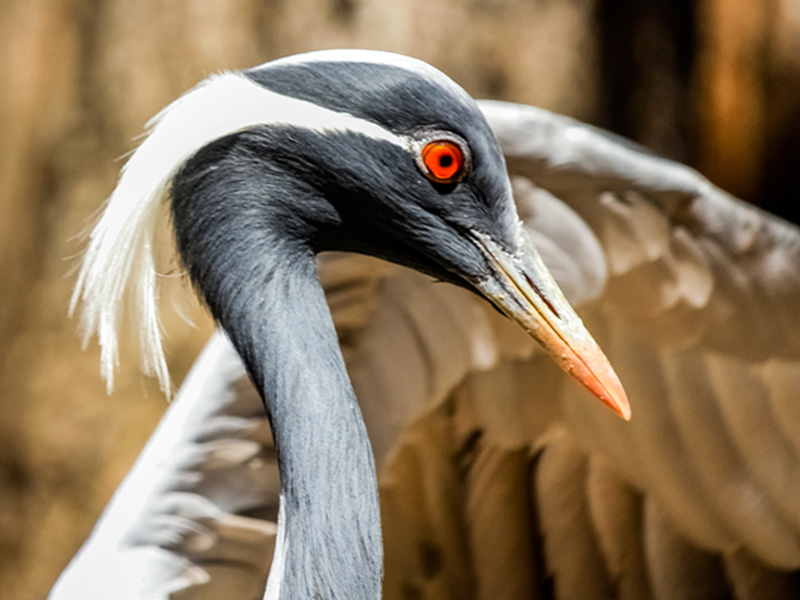
The demoiselle crane (Anthropoides virgo) is a migratory species that inhabits, in particular, grasslands, scrubland and areas near freshwater wetlands in European regions; as well as preferably plains steppe regions, although it is also found in high mountain valleys in Central Asia. The diet of this species consists mainly of plant matter (seeds, shoots, fruits), small vertebrates (primarily reptiles and amphibians) and various groups of invertebrates. Its feeding grounds are often found in wet fields and marshes, as well as in cultivated areas.
It is a long-distance migratory bird that spent the summer on the Iberian Peninsula, breeding in spring and summer. When the cold weather arrives, its migratory routes take it, above all, to the African continent. The post-breeding migration of this type of crane begins in late summer (August–September), returning in flocks from its wintering grounds to breed in March and April (sometimes as late as early June in the north). On arrival in the breeding areas, they behave in a gregarious or social manner for a few weeks, after which they become more territorial and subsequently nest in solitary pairs.
Although it is now extinct in Spain, it was a breeding species on the Iberian Peninsula until around a hundred years ago. In Spain, the demoiselle crane had two areas of distribution: the La Janda lagoon (Cádiz) was the most important site in Western Europe, with nests containing eggs recorded in this wetland until May 1906, although it is believed that some pairs survived until as late as the mid-20th century. Meanwhile, in Doñana and the Guadalquivir Marshes, the species was considered extinct by the end of the 19th century. It is highly likely that habitat transformation, the drainage of wetlands and excessive hunting were the reasons for its disappearance in Spain. Since 2018, the demoiselle crane has been included on the International Union for Conservation of Nature (IUCN) Red List of Threatened Species, with the main threats highlighted as being caused by human activity, although it has a global population of between 230,000 and 280,000 individuals and its trend is increasing.
Since the arrival of this species in 2026, Selwo Aventura has been involved in a breeding programme aimed at reintroducing the demoiselle crane into its natural habitat. We launched this programme in collaboration with the Iberian Association of Zoos and Aquariums (AIZA), which coordinates zoos on the Iberian Peninsula, and the Group for the Rehabilitation of Native Fauna and its Habitat (GREFA), an organisation widely recognised in Spain for its work in the rehabilitation and reintroduction of native wild animals. The aim of the project is to reintroduce individuals and establish stable breeding populations in the species’ former range.